
You have probably read a forum post or two claiming that a white powder from your kitchen shelf can wipe out a bed bug infestation. Diatomaceous earth for bed bugs has become one of the most searched bed bug home remedies that actually work in Bangalore, especially among people who want to avoid chemical sprays around kids or pets. But sprinkling powder along your bed frame without understanding how it works often ends in disappointment and more bites. Understanding what diatomaceous earth for bed bugs can and cannot do before you start is the difference between a treatment that works and money wasted on repeat bags.
Here is the direct answer: diatomaceous earth does kill bed bugs, but slowly and only under the right conditions. It works by damaging the waxy outer layer of adults and nymphs, causing them to dehydrate over days, not hours. It does not reliably kill bed bug eggs, which is why relying on it alone often leaves an infestation only partially treated.
In this guide, we walk through how diatomaceous earth kills bed bugs, how long it realistically takes, the correct application method, and where it falls short compared to professional treatment. If you have tried this route in your Koramangala flat or looked into bed bug treatment in Whitefield, Bangalore without success, you will also see when it makes sense to call in trained technicians instead.
Does diatomaceous earth actually kill bed bugs?
How diatomaceous earth kills bed bugs
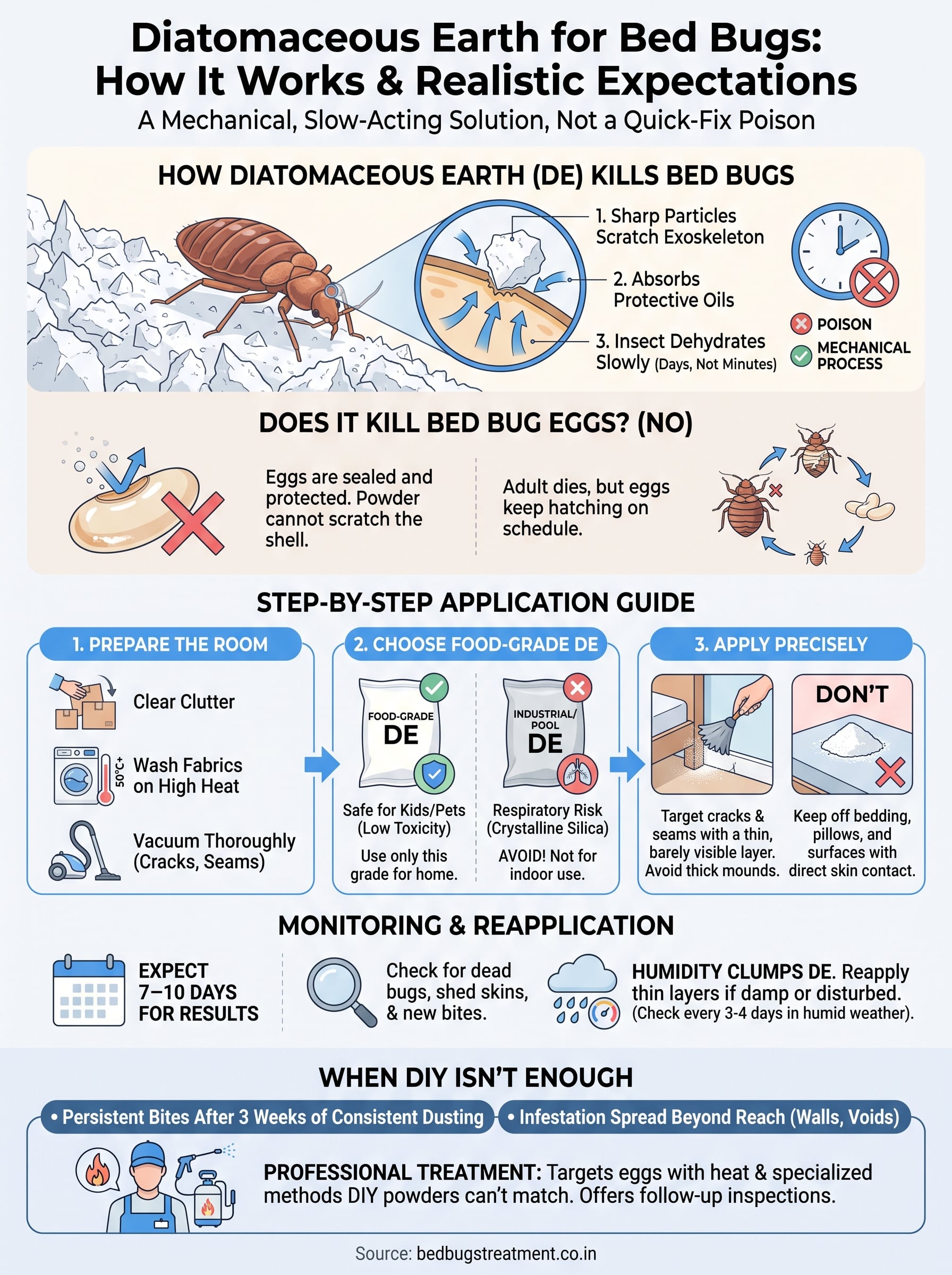
Diatomaceous earth is made from fossilized algae ground into a fine powder that looks harmless but is razor-sharp at a microscopic level. When a bed bug crawls through it, the sharp particles scratch through its waxy exoskeleton, and the powder absorbs the protective oils underneath. Without that coating, the insect loses moisture it cannot replace and dies of dehydration. This is a purely mechanical process, not a poison, which is exactly why so many Bangalore households reach for it as a chemical-free option. But mechanical also means slow: there is no knockdown effect like you get with a spray.
Diatomaceous earth does not poison bed bugs, it dries them out, and that takes days, not minutes.
Does diatomaceous earth kill bed bug eggs?
Here is where most DIY attempts fall apart. Does diatomaceous earth kill bed bug eggs? No, not reliably. Eggs are sealed inside a hard, glue-coated shell that the powder simply cannot scratch through, unlike the best bed bug sprays that kill eggs as well as adults. A female bed bug lays 1 to 5 eggs a day, and those eggs keep hatching on schedule, following the bed bug life cycle stages and timeline, even while the powder kills off crawling adults around them. So diatomaceous earth and bed bugs eggs are two separate problems, and treating only the visible bugs while ignoring the egg cycle is the single biggest reason people report the infestation keeps coming back. Anyone weighing diatomaceous earth for bed bugs as a full solution needs to plan for this gap from day one.
Step 1. Choose the right diatomaceous earth
Walking into a hardware store and grabbing the first bag labeled "diatomaceous earth" is the fastest way to waste your money. Only food-grade diatomaceous earth is safe to use inside a home with kids, pets, or elderly family members. The industrial version, sold for pool filters and drainage systems, is processed at higher temperatures and contains crystalline silica that can irritate lungs if inhaled repeatedly. If a bag doesn’t clearly say food-grade on the label, skip it, no matter how cheap it looks.
What to check before buying
Most Bangalore pharmacies don’t stock this, so you’ll likely order online. Before you buy, confirm these three things:
- The label says food-grade or NF grade, not "pool grade" or "filter grade."
- The particle size is fine enough to sit in cracks and along baseboards without clumping.
- The packaging has no added fragrances or anti-caking agents, which reduce effectiveness against bed bugs.
If the bag doesn’t say food-grade, put it back, no exceptions when kids or pets are in the house.
Food-grade vs. industrial grade at a glance
| Feature | Food-grade DE | Industrial/pool-grade DE |
|---|---|---|
| Safe around kids and pets | Yes, low toxicity | No, respiratory risk |
| Crystalline silica content | Very low | High |
| Common use | Pest control, supplements | Pool filtration, industrial |
| Recommended for bed bugs | Yes | Never |
Once you’ve confirmed the grade, check the quantity. A single bedroom with a bed frame, skirting boards, and a couple of cupboards typically needs 200 to 400 grams for one full application cycle. Buying a 1 kg bag is usually more economical than repeat small orders, since you’ll need to reapply over several weeks as you monitor the infestation. Buying the right quantity of diatomaceous earth for bed bugs upfront also saves a second online order mid-treatment, when you can least afford the delay.
Step 2. Prepare the room before treatment
Clear the clutter first
Before you open that bag of diatomaceous earth, spend an hour clearing the room. Bed bugs hide in clutter, so pull books, clothes, and boxes away from walls and baseboards. Anything that touches the floor or a wall gives bugs a bridge to travel on, which defeats the purpose of a barrier treatment. If you skip this step, you’ll end up dusting powder over piles instead of the actual entry and exit points bed bugs use.
Wash and isolate fabrics
Next, strip the bed and wash everything, including sheets, pillowcases, and any clothing stored near the mattress, on the hottest setting the fabric allows. Heat above 50°C kills bed bugs and eggs on contact, which the EPA confirms is one of the few reliable non-chemical methods available. Seal washed items in plastic bags until the room treatment is complete, so nothing gets re-infested while you’re working on the frame and furniture.
Wash fabrics on high heat first, diatomaceous earth only works on what’s left crawling around after that.
Vacuum before you dust
Vacuuming right before application removes visible bugs, shed skins, and loose eggs that would otherwise sit under the powder untouched. Run the vacuum slowly along these areas:
- Mattress seams and piping
- Bed frame joints and headboard cracks
- Skirting boards and baseboard gaps
- Carpet edges near the bed
Empty the vacuum bag or canister outside immediately, since live bugs can crawl back out. This single step is often the difference between a treatment that works within a few weeks and one that drags on because you’re applying powder over a fresh batch of hidden survivors. Skipping the vacuum step is one of the most common reasons diatomaceous earth for bed bugs seems to fail even when everything else was done correctly.
Step 3. Apply diatomaceous earth to hiding spots
Where to focus your application
Target the cracks and seams bed bugs actually use, not the open floor. How to use diatomaceous earth for bed bugs effectively comes down to precision: dust along the bed frame joints, under the mattress piping, inside box spring corners, and along skirting boards where the wall meets the floor. Nightstands, headboards, and any furniture touching the bed frame need the same treatment, since bed bugs travel along these bridges at night to feed and retreat before dawn.
Apply a thin, even layer
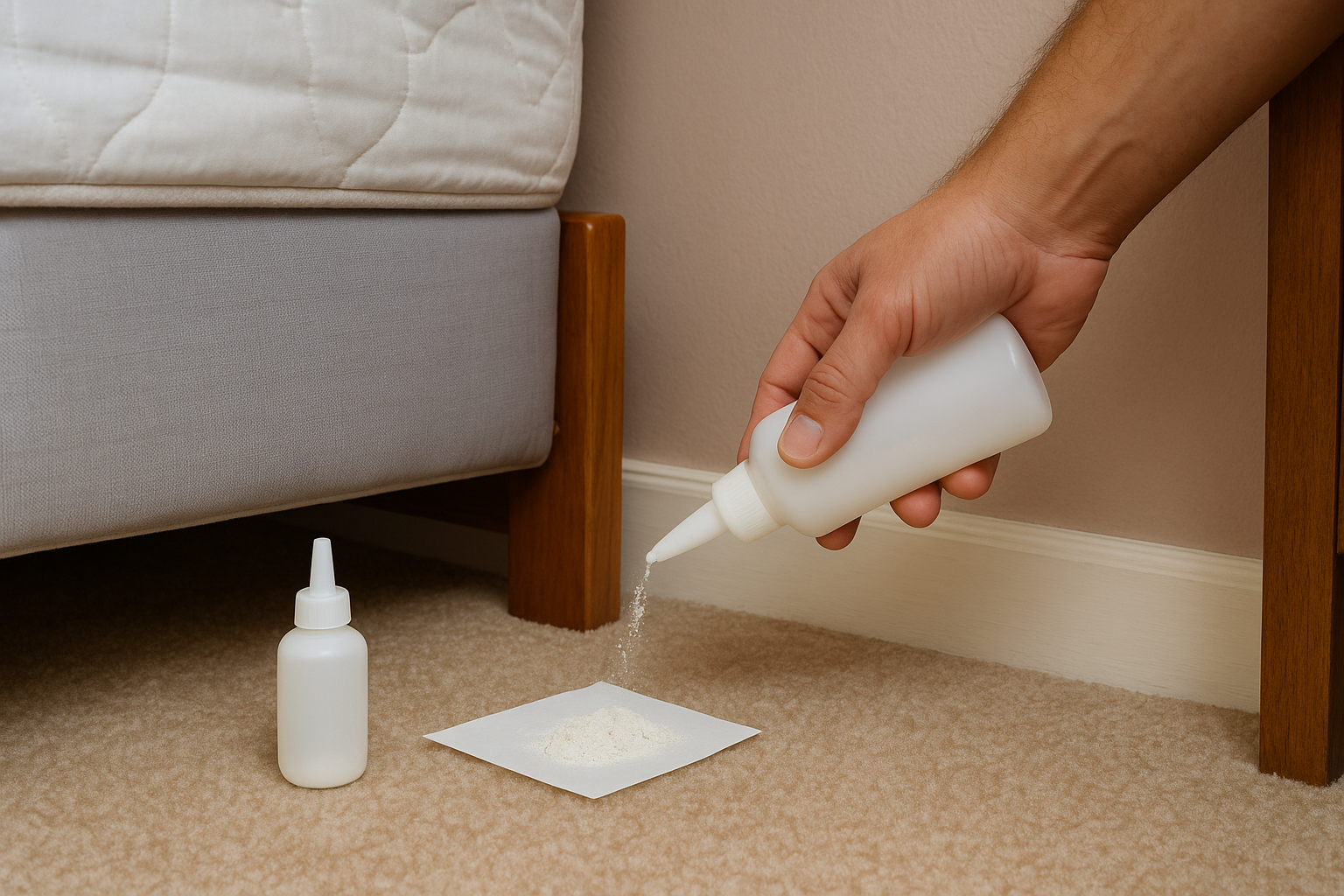
A heavy pile of powder is not more effective, it just gets brushed aside and avoided. Use a small puffer duster or an old paintbrush to work the powder into gaps rather than pouring it from the bag.
- Load a small amount of powder into a puffer bottle or squeeze it gently from a folded paper card.
- Dust a thin, barely visible layer into cracks, not a visible white mound.
- Cover baseboards, bed frame joints, and behind switchboards near the bed.
- Leave carpeted areas near the bed lightly dusted, then let it sit undisturbed.
A thin, invisible layer works better than a thick pile bed bugs can simply walk around.
Areas to avoid dusting
Skip the mattress surface itself, since a layer there gets disturbed every time you sleep and can be inhaled while lying down. Keep it off pillows, blankets, and anything in direct skin contact through the night. Overapplying near air vents or fans is also worth avoiding, since airflow scatters the powder away from the cracks where it needs to sit and work.
Step 4. Monitor results and reapply safely
Patience matters more than a second application at this stage. How long to kill bed bugs with diatomaceous earth depends on exposure, but expect 7 to 10 days before you see a real drop in activity, and up to 3 weeks before you can call an area clear. Adults that walk through a fresh dusting die within 2 to 4 days, while nymphs that avoid direct contact can survive longer on stored moisture. Checking daily instead of weekly gives you a much clearer picture of whether the powder is actually working or just sitting untouched. Daily checks are especially important the first time you use diatomaceous earth for bed bugs, since you have no baseline yet for how your specific infestation responds.
What to check during monitoring
Grab a flashlight and run a step-by-step bed bug inspection over the same spots you dusted, looking for the signs below:
- Dead bugs or shed skins caught in the powder
- Fresh dark spotting (droppings) near baseboards or seams
- New bite marks appearing overnight
- Powder that’s clumped, damp, or disturbed and needs redoing
If you’re still finding fresh bites after two weeks of consistent dusting, the powder alone isn’t cutting it.
When and how to reapply
Dampness is the biggest enemy of diatomaceous earth, since humidity clumps the powder and makes it useless as a drying agent. Bangalore’s monsoon months make this worse, and they are one reason bed bug numbers keep climbing in Bangalore apartments, so check treated areas every 3 to 4 days during humid weeks. Reapply a thin layer wherever the powder looks clumped, has visibly reduced, or was disturbed by cleaning or foot traffic. Vacuum out old residue before adding fresh powder rather than dusting over it, since compacted layers lose their sharp edges and stop working.
Tracking results this closely is really how you find out whether you can kill bed bugs with diatomaceous earth on your own or whether the infestation has outgrown a DIY bed bug control guide approach. A steady decline in sightings over three weeks is a good sign. No change, or new bites despite reapplication, tells you it’s time to stop guessing and get an inspection.
FAQ: Diatomaceous earth for bed bugs
Does diatomaceous earth actually kill bed bugs?
Yes, but slowly. It scratches through the waxy exoskeleton of adults and nymphs, causing them to dehydrate over days rather than minutes. There is no instant knockdown like a spray.
Does diatomaceous earth kill bed bug eggs?
No, not reliably. Eggs are protected by a hard, glue-coated shell that the powder cannot scratch through, so they keep hatching on schedule even while the powder kills crawling adults nearby.
How long does diatomaceous earth take to kill bed bugs?
Expect 7 to 10 days before you see a real drop in activity, and up to 3 weeks before you can call an area clear. Adults that walk through a fresh dusting typically die within 2 to 4 days.
What type of diatomaceous earth should I use for bed bugs?
Only food-grade (or NF grade) diatomaceous earth. Industrial or pool-grade versions are processed at higher temperatures, contain higher crystalline silica, and pose a respiratory risk, especially around kids and pets.
Where should I apply diatomaceous earth for bed bugs?
Dust a thin layer into bed frame joints, box spring corners, skirting boards, baseboards, and furniture bridging the bed. Avoid the mattress surface, pillows, and areas near airflow or vents, where the powder gets disturbed or scattered.
Why isn’t diatomaceous earth working on my bed bugs?
Usually one of three reasons: humidity has clumped the powder, eggs are hatching faster than adults are dying, or the infestation has spread into wall voids or wiring the powder cannot reach. If fresh bites continue after two to three weeks of consistent dusting, it’s time to call a professional.
When DIY treatment isn’t enough
Diatomaceous earth for bed bugs has a real place in bed bug control, but it’s a slow, partial tool, not a complete fix. It kills adults and nymphs over days, does nothing to eggs, and clumps the moment Bangalore’s humidity gets to it. If you’ve dusted every crack for three weeks and you’re still waking up with fresh bites, the infestation has likely spread further than a powder can reach, into wall voids, wiring conduits, or a neighboring flat.
That’s the point where professional bed bug treatment earns its cost. Trained technicians target eggs directly with heat and approved chemical methods DIY powders simply can’t match, backed by follow-up visits to confirm the job actually held.
Our own odorless bed bug treatment is built for exactly this situation: a 100% odorless, family-safe process that’s safe around kids, pets, and elderly residents, so there’s no chemical smell lingering in the room afterward. It combines heat, low-toxicity chemical, and steam options to reach adults, nymphs, and eggs in one pass, and every service comes with a 12-month warranty plus a 30-day money-back guarantee, so you’re not left guessing whether it held. If you’re in Koramangala, Indiranagar, HSR Layout, or anywhere else in the city and the powder isn’t cutting it anymore, arrange odorless bed bug treatment for Bangalore homes with a free inspection and get a real assessment instead of another guess.