
You wake up with itchy red bumps in a line down your arm, and now you can’t stop staring at your mattress seams. That gut check is the right instinct. A bed with bed bugs rarely announces itself with a full-blown swarm at first, it starts with small, easy-to-miss clues along the piping, tags, and folds of your mattress.
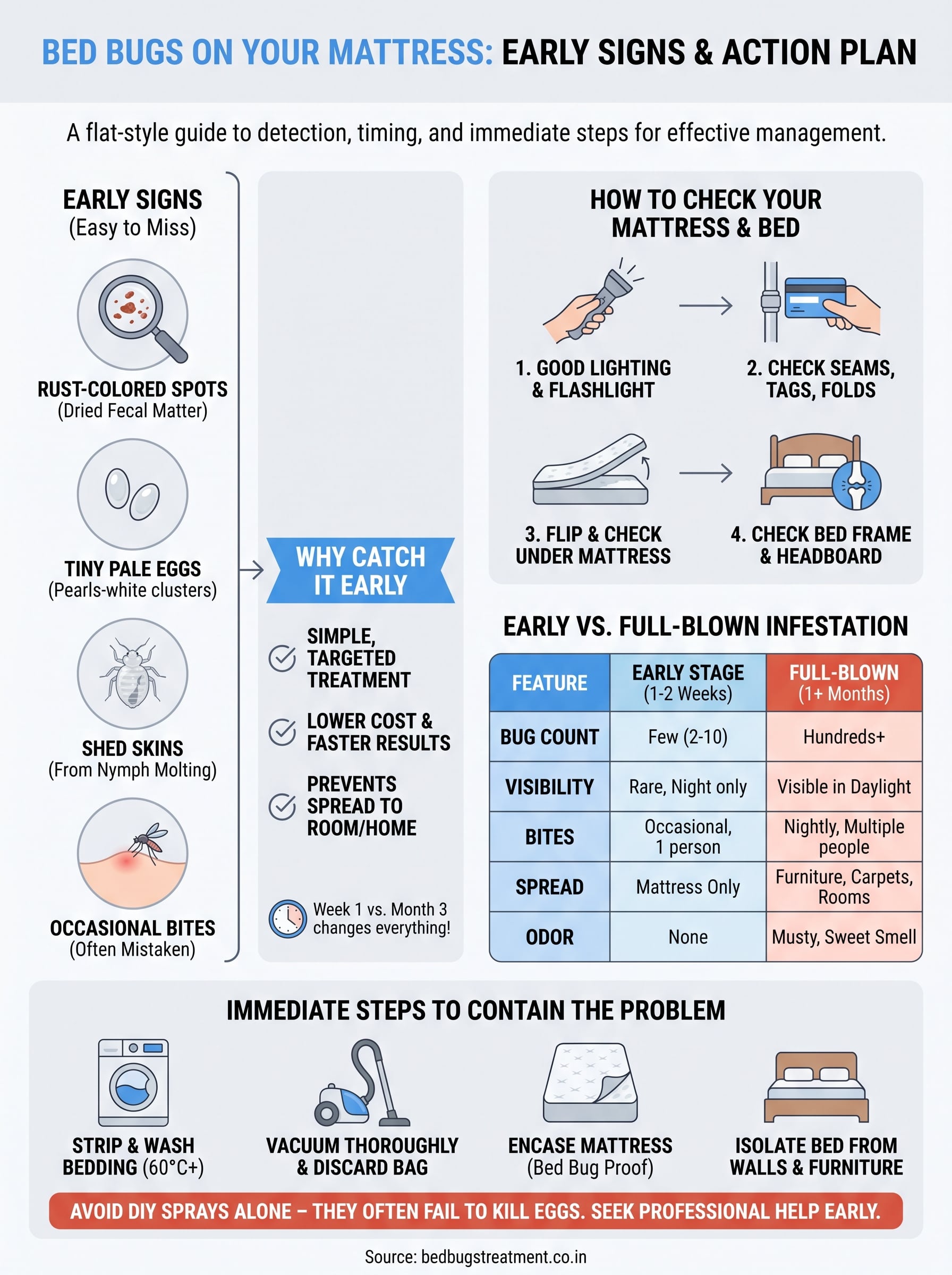
If you’re trying to figure out how to check bed bugs in mattress seams or want to know what does a bed bug infestation look like in its early stages, the answer comes down to a few specific markers: rust-colored spots, tiny pale eggs, shed skins, and a musty odor in bad cases. You don’t need special equipment to spot these, just good lighting, a flashlight, and knowledge of where to look.
In this guide, we’ll walk you through exactly how to find bed bugs on a mattress, tell early signs apart from other pest issues, and recognize when a few bugs have turned into a real infestation. We work bed bug cases across Bangalore every week, from Koramangala flats to Whitefield villas, so this is based on what we actually see in Indian homes, not generic checklists.
Why spotting bed bugs early on your mattress matters
Catching a bed bugs in the mattress problem in week one instead of month three changes everything about how the treatment goes, what it costs you, and how much sleep you lose in between. A single fertilized female bed bug can lay 200 to 500 eggs in her lifetime, and each egg hatches into a nymph within 6 to 10 days under the warm, humid conditions typical of Bangalore bedrooms, which is worth understanding through the full bed bug breeding timeline. What starts as two or three bugs hiding in a seam can become a colony of hundreds before you even notice a bite pattern.
A mattress with five bed bugs today can host five hundred within two months if nobody checks.
How fast an infestation grows
Bed bugs don’t need much time to turn a minor nuisance into a full-blown household problem. The table below shows roughly what happens when an infestation goes unchecked, based on typical breeding cycles we see in client homes across Koramangala, Indiranagar, and HSR Layout.
| Timeline | Approximate bed bug population | What you’ll typically notice |
|---|---|---|
| Week 1-2 | 2-10 bugs | Occasional bites, faint rust spots on mattress seams |
| Month 1 | 20-50 bugs | Clusters of eggs, shed skins in tags and piping |
| Month 2-3 | 200-500 bugs | Bugs visible in daylight, spreading to bed frame and headboard |
| Month 4+ | 1,000+ bugs | Infestation spreads to carpets, furniture, and adjoining rooms |
Once numbers hit that third row, you’re no longer dealing with a mattress problem. You’re dealing with a room problem, and sometimes a whole-apartment problem, especially in compact 1BHK and 2BHK layouts common across Bangalore.
Health and sleep consequences pile up
Beyond the math, there’s the toll on your body and your sleep. Bed bug bite symptoms in Bangalore homes show up as itchy, inflamed welts in most people, and repeated exposure over weeks can lead to secondary skin infections from scratching. Sleep disruption is the complaint we hear most often from clients, since knowing bugs are active at night makes it nearly impossible to rest even before you’ve confirmed the source. According to the CDC, bed bugs aren’t known to transmit disease, but the psychological stress of an active infestation, including anxiety and insomnia, is well documented and shouldn’t be dismissed as minor.
The cost of waiting keeps climbing
Delaying action doesn’t just cost you comfort, it costs you money. A localized infestation confined to one mattress and bed frame is far cheaper and faster to treat than one that’s spread through carpets, wardrobes, and adjacent rooms. We’ve handled Whitefield bed bug cases in villas where a two-week delay turned a single-room treatment into a whole-house job, tripling both the time and the cost involved. Getting bed bugs from mattress cleared out early, before eggs hatch into a second generation, is the single biggest factor in how quickly and affordably the problem gets solved.
Why this matters even more in rented or shared spaces
If you’re renting a flat or sharing a PG in Bangalore, an unchecked mattress infestation can spread to neighboring units through shared walls, furniture, or even hallway carpets, which is one big reason bed bug cases keep rising in city apartments. Landlords and flatmates rarely appreciate discovering bed bugs after they’ve already spread, and disputes over who caused the infestation and who pays for treatment get messier the longer it goes unaddressed. Spotting the signs early, before bugs migrate beyond your bed, keeps the problem contained, keeps your relationships with roommates or landlords intact, and keeps your treatment bill from ballooning into something much harder to justify.
How to check your mattress and bed for bed bugs
Grab a flashlight, a stiff card or old credit card, and a pair of gloves before you start this bed bug inspection, step by step. Checking a bed with bed bugs doesn’t require a professional kit, but daylight alone won’t cut it since these insects hide in the smallest gaps of piping and seams. Pull your sheets and mattress protector off completely, because a huge share of early activity hides underneath fitted sheets where nobody looks until bites start showing up.
Work through the mattress in sections
Having the right light source matters more than most people expect, since rust-colored stains and pale eggs blend easily into fabric under dim bulbs. Run your card along every seam, tag, and piping fold, since bed bugs wedge themselves flat into these tight spaces during the day. Look specifically for:
- Rust or brown spots (dried fecal matter or crushed bugs)
- Tiny, pearl-white eggs, often glued in clusters near seams
- Pale, papery shed skins from molting nymphs
- Live bugs, ranging from poppy-seed size (nymphs) to apple-seed size (adults)
If you find even one of these signs on your mattress, stop and treat it as bed bugs on a mattress, not a maybe.
Going further than the surface pays off here. Flip the mattress over and repeat the same seam-by-seam check on the underside, since bugs often prefer the side facing the floor or wall where there’s less disturbance. Checking bed bugs eggs on mattress folds specifically is worth the extra five minutes, since eggs are the clearest proof of an active breeding cycle rather than a stray hitchhiker.
Don’t stop at the mattress
Inspecting the bed frame, box spring, and headboard rounds out the check, since bugs migrate to wood joints, screw holes, and fabric-covered headboards once the mattress gets crowded. Unscrew what you can, and shine the flashlight into every joint and crevice. Slats, corners, and the underside of a box spring are classic hiding spots that people forget entirely while focused on the mattress top.
Knowing how to see bed bugs on mattress surfaces comes down to repetition, not luck, and comparing what you find against bed bug images at every life stage removes most of the guesswork. Most Bangalore clients we’ve inspected missed early signs simply because they checked once, saw nothing obvious, and assumed they were in the clear. Recheck weekly for two to three weeks if you’ve had any bites or found ambiguous stains, since a single pass can easily miss a small, early cluster.
What an early vs full-blown infestation looks like
Knowing what counts as early stages of bed bug infestation versus a problem that’s spiraled out of control helps you calibrate your response instead of panicking or ignoring warning signs. The gap between these two stages isn’t just about bug count, it’s about how visible, widespread, and disruptive the problem has become to your daily life.
Early stage: subtle and easy to miss
Spotting an early infestation means looking for a handful of tiny rust spots on one seam, maybe a single shed skin tucked in a mattress tag, and bites that show up sporadically rather than every night. At this stage, most people in Bangalore we’ve spoken with dismiss the marks as ink stains or assume the bites came from mosquitoes. There’s usually no smell, no visible daytime activity, and the signs stay confined to the mattress itself rather than spreading to furniture or walls.
A few rust spots on one mattress tag is still an early infestation, not proof you’re in the clear.
Full-blown infestation: unmistakable and urgent
Full-blown cases look completely different, and what is considered a bed bug infestation at this severity is obvious even without close inspection. You’ll see live bugs crawling in daylight, clusters of eggs in multiple locations, a sweet-musty odor from their scent glands, and bite patterns covering multiple family members every morning. Bugs have usually spread past the mattress into the bed frame, nearby furniture, and sometimes electrical outlets or wall cracks by this point.
Comparing the two side by side makes the distinction concrete:
| Feature | Early infestation | Full-blown infestation |
|---|---|---|
| Rust spots | 1-3 on one seam | Scattered across mattress, frame, wall |
| Eggs | Small isolated cluster | Multiple clusters, several locations |
| Live bugs seen | Rare, only at night | Visible in daylight |
| Odor | None | Musty, sweet smell |
| Bites | Occasional, one person | Nightly, multiple household members |
| Spread | Mattress only | Furniture, carpets, adjoining rooms |
Understanding what does bed bug infestation look like at each stage isn’t just academic, it changes your treatment plan entirely. Early cases often respond to a single targeted treatment on the mattress and bed frame, while full-blown infestations need whole-room heat treatment, multiple follow-ups, and sometimes coordination with neighboring flats if you live in a shared building. Waiting to act rarely buys you anything except a bigger bill and more sleepless nights.
Signs of bed bugs beyond the mattress
Bed bugs rarely stay confined to your mattress once a colony gets established, so how to find a bed bug infestation properly means checking well past the bed itself. Furniture, curtains, wall cracks, and even electronics near your bed can harbor bugs during the day, since they only need a gap the width of a credit card to hide in. Skipping this wider check is one of the most common mistakes we see in Bangalore homes, where clients treat the mattress and assume the job is done while bugs sit undisturbed six inches away in a nightstand joint.
Carpets, rugs, and flooring
Checking the floor around your bed matters just as much as the mattress itself. Signs of bed bugs in carpet include tiny rust-colored stains near the baseboard, especially along the edge closest to the bed frame, and small dark specks that don’t brush away easily since they’re dried fecal matter rather than dust. Run a flashlight at a low angle across the carpet pile near your bed legs at night, since that’s when bugs move to feed and you’re more likely to catch live movement.
If bugs have reached your carpet, they’ve already left the mattress and started colonizing the room.
Furniture, walls, and electronics
Look beyond soft furnishings too. Bugs favor tight, dark spaces regardless of material, so check these spots on a regular basis once you suspect an issue:
- Seams and folds of upholstered chairs or sofas near the bedroom
- Behind picture frames, switchboards, and loose wallpaper edges
- Inside wooden furniture joints, drawer tracks, and cupboard hinges
- Around window curtains and the tops of curtain rods
- Inside phone chargers, alarm clocks, or other electronics kept bedside
Spreading into these areas usually happens once the mattress population gets crowded, so finding bugs in a nearby cupboard almost always means the mattress itself is already heavily infested, not lightly.
Multiple rooms or shared walls
Travel patterns matter in apartments and PGs. Bugs hitchhike on clothing, bags, and even shoes, so check adjoining bedrooms, hallway carpets, and shared laundry baskets if you live with roommates or family. Widespread signs across multiple rooms almost always point to a longer-running infestation than the person living there realized, since bugs need weeks of unchecked breeding to migrate that far from the original bed.
What to do after finding bed bugs on your mattress
Finding proof on your mattress is the easy part, since saving an infested mattress is where the real work starts. What you do in the next 24 hours determines whether this stays a one-room problem or spreads through your flat. Start by isolating the mattress and bed frame from the rest of the room instead of dragging them out to the hallway, since moving infested items is one of the fastest ways to spread bugs to neighboring units in Bangalore apartment blocks.
Immediate steps to contain the problem
Getting the basics right early saves you money and stress later, and these DIY bed treatment steps cover most of what you can do yourself. Work through this list before you touch a spray can or call anyone:
- Strip all bedding, wash it in hot water above 60°C, and dry on high heat for at least 30 minutes
- Vacuum the mattress, bed frame, and surrounding carpet thoroughly, then seal and discard the vacuum bag outside your home
- Encase the mattress in a certified bed bug proof cover to trap remaining bugs and stop new bites, one step in clearing bed bugs out of a mattress for good
- Move the bed away from walls and curtains so bugs can’t bridge onto other furniture
- Avoid moving the mattress to another room, since that just relocates the infestation
Why DIY sprays often fail
Spraying alone has real limits: hardware store sprays kill visible bugs on contact but rarely touch eggs tucked deep in seams, and eggs hatch again within a week regardless of what you sprayed. We see this pattern constantly with Bangalore clients who treat once, feel confident, then get bitten again within ten days because the second generation was already incubating when they sprayed. Steam treatment works better than sprays for surface bugs, and only a handful of the strongest sprays that reach eggs too make a dent, but without proper heat penetration into the mattress core, you’re still leaving pockets of activity untouched.
Spraying visible bugs without treating eggs just resets the clock, it doesn’t end the infestation.
When to call a professional
Booking a proper inspection makes sense the moment DIY steps haven’t stopped new bites within a week, or if you’ve confirmed eggs or clusters rather than a single stray bug. Our free bed bug inspection gives you a clear read on how far the infestation has spread before you commit to a treatment plan, and technicians use heat, steam, or approved chemical methods depending on severity rather than a one-size-fits-all spray. Same-day scheduling across Koramangala, Indiranagar, and Whitefield means you’re not waiting weeks while the population multiplies further.
Getting your bedroom back from bed bugs
Spotting a bed with bed bugs early, rather than three months in, is what keeps a treatment simple instead of turning into a whole-flat ordeal. You now know where to look, from mattress seams and tags to carpets, headboards, and the furniture sitting quietly nearby. You know the difference between a few rust spots and a colony that’s already spread past your bed. That knowledge is the whole game here, since bed bugs thrive on being ignored.
Don’t wait for nightly bites to confirm what a flashlight check already told you. If you’ve found rust spots, shed skins, or live bugs on your mattress, get a professional opinion before the eggs you missed hatch into your next infestation. Book a free inspection with our Bangalore bed bug treatment team and get a clear, no-pressure read on what’s actually happening in your bedroom.